Do Voting Advice Applications Have Lasting Causal Effects? Evidence from Concurrent Survey and Field Experiments
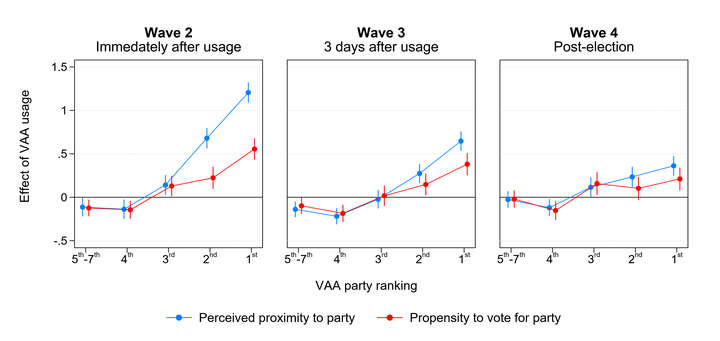 Effects of VAA usage on perceptions of policy proximity and the propensity to vote for parties
Abstract
Voting Advice Applications (VAAs) are used by millions of voters, yet their causal impacts on political knowledge, preferences, and behavior remain unclear. We present new evidence from two complementary experiments conducted during the 2024 UK General Election: (1) a panel survey experiment with a novel design that provides access to participants’ VAA advice, increases compliance with treatment assignment, and allows us to track outcomes over time; (2) a concurrent field experiment embedded in a real-world VAA that allows us to assess the ecological validity of our findings. We find that VAA usage leads to durable changes in voters’ knowledge of how close they are to parties on policy issues, shifts party preferences in line with the advice received, and affects the vote choices of undecided voters. These results suggest that VAAs play an important role in election campaigns. However, we find no evidence that VAAs increase electoral participation.