Restrictions of Ethnic Group Rights and the Violent Escalation of Self-Determination Conflicts
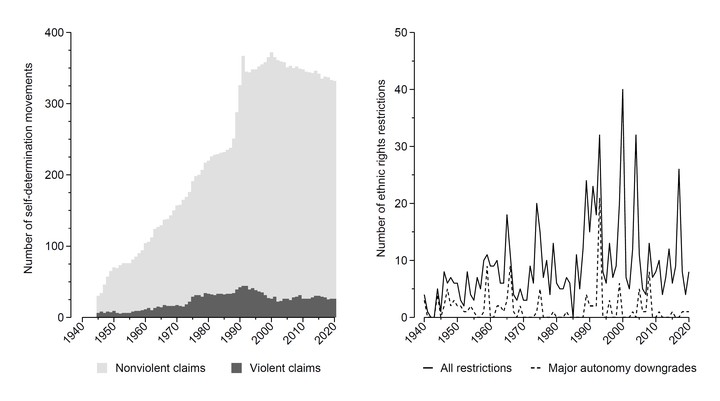 Annual counts of the number of self-determination claims and ethnic rights restrictions
Abstract
The reasons why self-determination conflicts escalate from nonviolent claims to violence remain poorly understood. I argue that restrictions of ethnic rights – a form of nonviolent repression – are likely to significantly increase the risk of conflict escalation, especially in their immediate aftermath when grievances are still fresh. Drawing on new data and difference-in-differences estimation, I find support for my argument in an analysis covering all self-determination disputes between 1945 and 2020. Critically, I find that both major autonomy downgrades and other types of ethnic rights restrictions lead to similarly sized increases in the risk of conflict escalation, suggesting that ethnic rights restrictions constitute a more important explanation of separatist violence than previously thought. Finally, I find evidence that the escalatory potential of ethnic rights restrictions is highest where groups have pre-existing grievances against the state and the opportunity structure incentivizes violent tactics, pointing to the value of combining structural and dynamic theories of civil war.